 how-to
Get Complimentary Room Upgrades at Caribbean Resorts
Table of Contents
- Understanding How Complimentary Room Upgrades Work at Resorts
- When to Ask for a Room Upgrade at Check-In
- How to Write a Hotel Upgrade Request Email
- Loyalty Status and Room Category Strategy
- Benefits of Booking Resorts Through Travel Agencies
- Timing Your Request: Peak Season vs. Shoulder Season
- Common Mistakes That Hurt Your Upgrade Chances
- Frequently Asked Questions
Last Updated: September 30, 2026
Understanding How Complimentary Room Upgrades Work at Resorts
Complimentary room upgrades happen when a hotel moves you to a better room at no extra cost. This isn't luck, it's the result of how resorts manage their inventory and guest relationships.
Resorts use revenue management systems to track availability and guest profiles. When a premium room sits empty and a guest matches the right profile, front desk agents can offer an upgrade. The key is positioning yourself as that ideal guest.
Front desk staff evaluate loyalty status, booking method, prior stays, and occupancy levels. Direct bookings get priority over third-party reservations. Loyalty members are flagged in the system before arrival. Special occasions like anniversaries and birthdays are noted and remembered.
When to Ask for a Room Upgrade at Check-In
The moment you arrive at check-in is your prime opportunity, but how you ask matters far more than when. Front desk agents process dozens of check-ins daily, and their decision to offer an upgrade hinges on psychological factors most guides ignore: perceived guest value, emotional rapport, and operational context.
The Psychology of the Front Desk Interaction
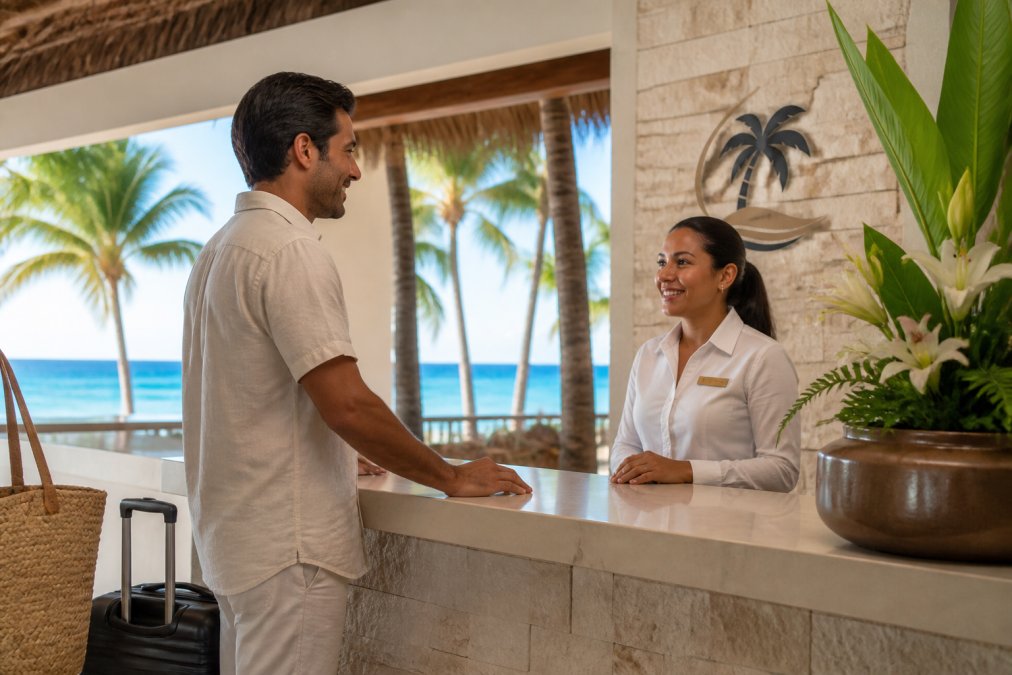
Front desk agents assess guest profiles within seconds, looking for signals of calm demeanor and respect. Research shows guests who establish rapport, greeting warmly, using the agent's name, acknowledging their role, receive upgrades at significantly higher rates.
The tone of your request is the single most important variable. Compare these two approaches:
Ineffective: "I booked a standard room, but I'd like an upgrade if you have one available."
Effective: "Hi [name], thanks so much for helping us today. We're really looking forward to our stay. I know you probably get this request often, but if there's any possibility of a room upgrade, we'd be incredibly grateful. Either way, we're just excited to be here."
This approach humanizes the interaction, acknowledges the agent's authority, and signals satisfaction regardless of outcome, removing the agent's fear of complaints.
Timing Within the Check-In Window
Peak check-in hours (3-6 p.m.) are when agents are busiest and least empowered. Arriving between 11 a.m. and 2 p.m. is ideal, the agent has time to review your profile and consider options.
Late arrivals can work if the resort has oversold standard rooms, but this is unpredictable and shouldn't be your strategy.
The Soft Upgrade vs. Hard Upgrade Framework
Understanding this distinction changes how you prepare:
-
Soft upgrade: The agent offers it without you asking. They see your profile (loyalty status, special occasion note, prior stays) and proactively suggest a better room. This happens because you've positioned yourself correctly in advance through email communication and loyalty enrollment.
-
Hard upgrade: You request it at check-in. The agent wasn't planning to offer one, but your respectful ask and positive demeanor trigger them to check availability and make an exception.
Soft upgrades occur when the agent proactively offers one based on your profile. Hard upgrades depend on current availability and the agent's perception of you.
What to Avoid
Don't ask via email before arrival, this creates a paper trail that often results in decline. Don't demand an upgrade, mention you deserve one, or discuss price. These trigger defensive responses and signal you're transactional, not relationship-focused.
Instead, approach the desk with genuine warmth, make eye contact, smile, and lead with gratitude. Say something like: "We're so excited to stay here. Is there any possibility of a room upgrade available?" Simple. Honest. Respectful. This phrasing works because it's not a demand, it's a question that gives the agent permission to say no without feeling like they've disappointed you.
How to Write a Hotel Upgrade Request Email
Email requests work best when sent 5-7 days before arrival, giving the resort time to flag your profile in their system.
Keep your email short. One paragraph is ideal. Include these elements:
- Your confirmation number
- Your arrival date
- A brief reason (anniversary, honeymoon, special celebration)
- A polite request for consideration
Here's a template:
Dear [Hotel Name] Team,
We're arriving on [date] with confirmation #[number]. We're celebrating our anniversary this trip and would love to make it extra special. If a room upgrade is available, we'd be so grateful. Thank you for considering us.
Best regards, [Your name]
Send to the resort's reservations email. Call ahead for a direct contact, it shows effort and gets better results.
Authenticity wins over elaborate narratives. A genuine celebration beats a fabricated one every time.
The email creates a paper trail. When you arrive, the agent sees your request in the system, strengthening your position as someone who communicated professionally in advance.
Loyalty Status and Room Category Strategy
Loyalty status remains one of the strongest upgrade levers, but mechanics have shifted since 2020. Understanding modern constraints is critical to setting realistic expectations.
How Loyalty Status Influences Upgrade Decisions
Loyalty program members are flagged in the system before arrival and receive priority consideration. Higher tiers get better treatment, the system highlights loyalty status, prior stays, and lifetime value.
Join before booking, most programs are free and take two minutes. Your status automatically flags your reservation.
Loyalty status improves your odds but doesn't guarantee an upgrade, it's one variable among several that revenue management systems evaluate.
The 'Book One Tier Down' Strategy, and Its Modern Limitations
Traditional upgrade advice recommends booking a room category one level below what you actually want. If you'd love a beachfront suite, book a standard ocean view. This gives the resort room to upgrade you without losing revenue on the category you booked.
This strategy still works, but with an important caveat: it only works if the resort has manual override authority. Modern revenue management software, systems like IDeaS (used by major hotel chains) and similar platforms, now automatically optimizes room inventory based on demand forecasting, pricing, and occupancy. These systems calculate the revenue impact of every room assignment in real time.
When occupancy is high (80%+), the software rarely allows manual upgrades because every room is revenue-optimized. The front desk agent literally cannot override the system without manager approval, which is rarely granted. When occupancy is low (60% or below), manual overrides are more common because the software has already priced rooms aggressively to fill inventory.
The 'book one tier down' strategy is most effective during shoulder season (April-May, September-November) when occupancy sits at 70-80%, the sweet spot where software allows flexibility.
Room Category and Inventory Guarantees
When you book a specific room category, you're guaranteed that tier or better. The resort cannot downgrade you. But they can upgrade you, if the system permits and availability exists.
Room categories to consider:
- Standard/Garden View: Maximum upgrade potential but competing with many guests.
- Ocean View/Partial Ocean View: Smart compromise, positioned for suite or premium oceanfront upgrade.
- Beachfront/Suite: Already in best category; upgrades unlikely.
Length of Stay and Upgrade Likelihood
Guests staying three nights or longer get upgraded more frequently. Longer stays generate more revenue and give the revenue management system more flexibility.
If you're flexible on dates, a longer stay increases your chances. Resorts reward loyalty through duration. A three-night stay in shoulder season at 70% occupancy is your ideal scenario for upgrade success.
Pre-Arrival Communication and System Flagging
Check your reservation before arrival. Ensure special occasions (anniversary, honeymoon, milestone birthday) are noted in comments. If not, call the resort and ask the reservations agent to add it.
This creates a system flag the front desk sees at check-in, increasing the likelihood of a soft upgrade without you asking.
The Post-Pandemic Reality: Revenue Management Software Constraints
Since 2021, most Caribbean resorts have upgraded revenue management systems that control room assignments more tightly.
To maximize your chances in this environment:
- Book during low-occupancy periods (shoulder or off-season) when the revenue management system has more flexibility.
- Use loyalty status to get flagged in the system as a priority guest.
- Communicate special occasions in advance so the system flags your reservation.
- Be realistic about upgrade scope, expect a view or floor upgrade more often than a category upgrade.
- Ask respectfully at check-in, but understand that the agent's hands may be tied by the system.
Benefits of Booking Resorts Through Travel Agencies
Travel agencies access inventory and upgrade opportunities that online booking sites don't, tapping into decades of industry relationships.
Timing Your Request: Peak Season vs. Shoulder Season
Peak season (December-March) is when upgrades are rarest. Occupancy hits 95%+ and resorts have no empty suites to offer.
Common Mistakes That Hurt Your Upgrade Chances
Booking through third-party sites with non-refundable rates signals low value. Book direct or through an agency when upgrades matter.
Frequently Asked Questions
What should I include in an email requesting a complimentary room upgrade?
Keep your request professional and specific. Mention your confirmation number, arrival date, and the reason for your request (anniversary, special occasion, or loyalty status). Explain what room category interests you and why. Be polite and express appreciation for their consideration. Send the email 2-3 weeks before arrival to the resort directly or through your travel advisor. A concise, genuine request, one or two short paragraphs, gets better results than lengthy explanations.
Do travel advisors have better success securing complimentary room upgrades than booking direct?
Yes, travel advisors often have stronger relationships with resort management. Advisors backed by host agencies can advocate on your behalf and sometimes negotiate upgrades as part of package deals. They understand occupancy patterns and can time requests strategically. However, success depends on the resort, your loyalty status, and booking timing, not the advisor alone. Professional advisors can improve your odds, but upgrades are never guaranteed.
What is the best time of year to request a complimentary resort upgrade?
Shoulder season (April-May and September-November) offers the best upgrade chances because occupancy rates drop and resorts have more inventory flexibility. Peak season (December-March) makes upgrades harder due to high demand and full capacity. Summer and early fall see fewer tourists, so resorts are more willing to offer complimentary upgrades to fill higher-category rooms. Avoid major holidays and school vacation weeks when occupancy spikes. Booking 2-3 weeks in advance during slower periods increases your chances significantly.
How does loyalty status impact your chances of a free room upgrade?
Loyalty status is one of the strongest factors resorts consider for upgrades. Elite members receive priority treatment, guaranteed upgrades on some bookings, and access to better room categories. Even entry-level loyalty membership improves your odds compared to non-members. Resorts track your stay history and spending, so frequent guests get preferential treatment. If you don't have status, mentioning a special occasion or booking through an advisor can partially compensate, but loyalty membership directly influences upgrade eligibility and room assignment.