 how-to
How to Ask for a Free Suite Upgrade at Check In
Table of Contents
- The Real Rules of Complimentary Suite Upgrades
- The Best Time to Ask for a Hotel Upgrade
- What to Say to Get a Room Upgrade: The Soft Ask vs. Hard Ask
- Check-In Etiquette and Timing That Boost Your Chances
- When to Stop Asking: Reading the Front Desk Agent
- Conclusion: Turning a Request Into a Relationship
- Frequently Asked Questions
Last Updated: October 2, 2026
The Real Rules of Complimentary Suite Upgrades
Knowing how to ask for a free suite upgrade at check in starts with one truth: hotels give upgrades when it costs them nothing and earns them something. This guide breaks down the timing, scripts, and etiquette that work.
Why Hotels Give Free Upgrades
A hotel upgrade is a room assignment decision, not a gift. Agents hand out better rooms when your booked room is oversold, when the hotel wants to reward loyalty, or when your request is easy to grant. Because agents have wide latitude, a warm, low-pressure request often beats a demanding one.
Complimentary vs. Paid Upgrades: What You're Actually Asking For
A complimentary upgrade is a free move to a better room category, granted at the hotel's discretion. A confirmed upgrade is a paid or points-based booking locked in before arrival. A free upgrade asks the agent to use their judgment; a paid one buys certainty.
| Upgrade Type | How You Get It | Certainty | Best For |
|---|---|---|---|
| Complimentary | Ask at check-in or pre-arrival | Low | Flexible travelers, off-peak dates |
| Confirmed (paid) | Book or bid before arrival | High | Special occasions, firm plans |
| Loyalty award | Redeem points or elite status | Medium | Frequent guests with status |
The Best Time to Ask for a Hotel Upgrade
The best time to ask for a hotel upgrade is during off-peak check-in, ideally mid-afternoon on a low-occupancy day. Timing beats charm because room assignment runs on inventory.
How Room Inventory Actually Works
A hotel does not have a single pool of rooms. It has room types with fixed counts, matched against reservations each night. Three things determine whether a suite is available to give away:
- Physical inventory. If all suites are booked, there is nothing to upgrade you into, regardless of status or charm.
- Forecasted occupancy. If the forecast is high, suites are held for paying guests. If it is low, the hotel would rather fill a suite with an upgraded guest than leave it empty.
- Length of stay and arrival pattern. A one-night stay is easier to upgrade than a five-night stay, because the hotel can re-sell the suite the next night. A mid-week arrival is easier than a Friday.
This is why the same request that fails on a holiday weekend succeeds on a slow Tuesday. The room did not change. The math did.
Pre-Arrival Email vs. Physical Check-In
Both windows work, but they do different jobs. A pre-arrival email plants a seed; physical check-in closes the deal.
Send your email two to three days before arrival, when the property management team has a rough picture of inventory.
At the desk, the best moment is when there is no line behind you.
Reading the Occupancy Signals
You can estimate your odds before you walk in:
- Day of week. Sunday through Tuesday nights are typically the softest. Friday and Saturday are the tightest.
- Season. Shoulder seasons and off-peak travel dates are when suites sit empty.
- Local events. A convention, a game, or a festival can fill a hotel that would otherwise have space.
- Booking pace. If most room types are still available a few days out, your odds are better than if only the highest categories remain.
None guarantee anything, but they tell you whether the ask is worth making.
When the Hotel Is Full
If the hotel is sold out, no script will get you a suite. Ask about a paid upgrade or a future-stay note; some properties will flag your profile for a complimentary upgrade on a later, quieter stay.
At Sand and Sun Travels, our advisors can help you plan your trip to maximize your chances for upgrades.
What to Say to Get a Room Upgrade: The Soft Ask vs. Hard Ask
The soft ask works far more often than the hard ask. A soft ask gives the agent room to say yes without pressure. A hard ask corners them, and cornered people say no.
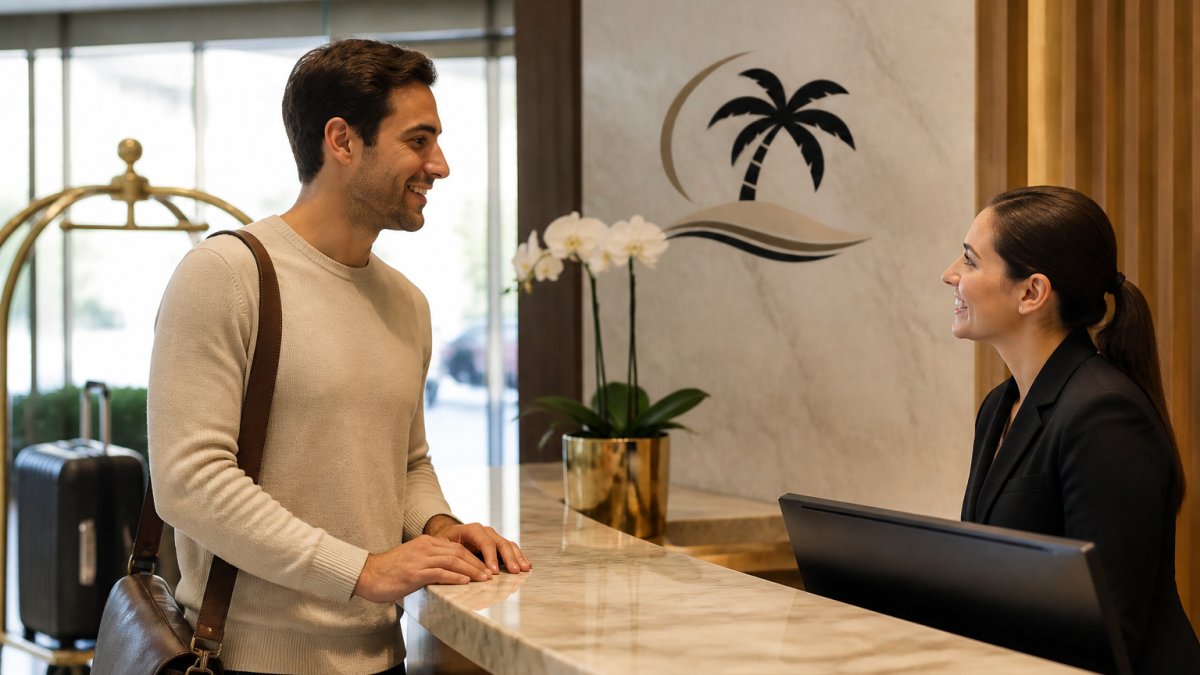
Here is the difference in practice:
- Soft ask: "If there's any chance of a better room, we'd be thrilled. If not, no worries at all."
- Hard ask: "I want a free suite upgrade. Can you do that for me?"
The soft ask wins because it respects the agent's discretion and gives them an easy out.
, a small requestHi [Hotel] team,
We're excited for our stay from [arrival date] to [departure date] under the name [last name].
If there's any chance of a room upgrade during our visit, we'd be grateful.
Keep it short. Keep it warm. Send it two to three days out.
Check-In Etiquette and Timing That Boost Your Chances
Check-in etiquette is simple: be easy to help. Arrive at a quiet time, have your reservation details ready, and treat the agent like a person.
Timing rules that work:
- Aim for mid-afternoon, after the morning rush
- Avoid arriving right at standard check-in time when lines form
- Skip the ask if the lobby is packed
Small courtesies go far: use the agent's name if it is on their badge, and ask how their day is going.
American Hotel & Lodging Association industry guidance notes that guest relations and service recovery are core hospitality skills, which is why a friendly guest often gets more leeway.
When to Stop Asking: Reading the Front Desk Agent
Stop asking the moment the agent signals no. Pushing past that point can turn a maybe into a firm no.
Watch for these signals:
- A flat "unfortunately, we're fully committed"
- A quick glance at the screen with a tight smile
- An offer of a paid upgrade instead
That last one is not a rejection but a counteroffer. If the price is fair and the occasion matters, take it; if not, decline politely and move on.
Conclusion: Turning a Request Into a Relationship
The travelers who get upgrades most often are not the loudest. They ask once, kindly, at the right moment.
A free suite upgrade is never guaranteed.
That is where Sand and Sun Travels comes in.
Request a quote with Sand and Sun Travels and let our team handle the details while you enjoy the journey.
Frequently Asked Questions
What is the best way to ask for a room upgrade at check-in?
The best approach is the 'soft ask', a friendly, low-pressure request made while handing over your ID and credit card. Smile, make eye contact, and say something like, 'If there's any chance of a complimentary upgrade, I'd really appreciate it.' This works because it gives the front desk agent room to say yes without feeling cornered. Avoid demanding language or implying you're entitled to an upgrade. Agents respond far better to warmth than pressure.
Does mentioning a special occasion actually help get a room upgrade?
Yes, but only when it's genuine and mentioned early. Telling the front desk it's your honeymoon, anniversary, or birthday gives the agent a legitimate reason to assign you a better room category. The key is to mention it during booking or in a pre-arrival email, not as a last-second negotiation tactic at check-in. Hotels track these details in reservation notes, and agents are more willing to upgrade a guest who has a real reason to celebrate.
Is it better to ask for an upgrade via email or in person?
Both have advantages. A pre-arrival email reaches the front office manager or guest relations team when they're planning room assignments, often 24 to 48 hours before arrival. That's when suite availability is most flexible. In-person requests at check-in work when the hotel isn't fully booked, and you can read the agent's response in real time. The strongest strategy combines both: send a polite email, then follow up with a warm in-person ask.
Are free room upgrades common for non-loyalty members?
They're less common but not impossible. Loyalty status and elite status give members priority for upgrade awards, but hotels still have rooms they need to fill. Non-members can improve their odds by booking direct, traveling during off-peak dates, arriving early in the check-in window, and being genuinely pleasant to the front desk agent. Properties with low occupancy rates are far more likely to grant complimentary upgrades to any polite guest.