 how-to
How to Negotiate a Room Upgrade at the Front Desk
Last Updated: October 22, 2026
Quick Summary
To negotiate a room upgrade at the front desk, ask politely and in person, stay flexible on room type, and arrive mid-afternoon after standard check-in opens when the agent can see the night's real room inventory. Keep the request short, mention any loyalty status or real occasion, and confirm the all-in nightly cost before accepting a paid upgrade.
- Ask for a room upgrade mid-afternoon, not during peak check-in with a line behind you.
- Join the loyalty program before check-in so the agent gets a system prompt to check upgrade eligibility.
- Book direct, since the front desk can usually reprice or upgrade direct bookings on the spot.
- Ask for the all-in nightly difference, because room tax and resort fees can raise a $40 upgrade to $55 or $60.
- If told no, ask the agent to note your request in case something opens up later.
Table of Contents
- How to Negotiate a Room Upgrade at the Front Desk: What to Know Before You Ask
- What Counts as a Room Upgrade and How to Compare Value
- The Hotel Room Upgrade Request Script That Works
- Best Time to Ask for a Hotel Room Upgrade
- Hotel Room Upgrade Cost: What You Might Pay and How to Check
- How to Get a Free Hotel Room Upgrade
- Step-by-Step Check-In Decision Tree: From Ask to Acceptance or Refusal
- Frequently Asked Questions
How to Negotiate a Room Upgrade at the Front Desk: What to Know Before You Ask
A room upgrade at the front desk comes down to three things: a polite ask, real flexibility, and timing. Guests who arrive mid-afternoon, smile, and ask what is available tend to do better than those who demand. This guide shows you how to ask, what to say, and when to walk away.
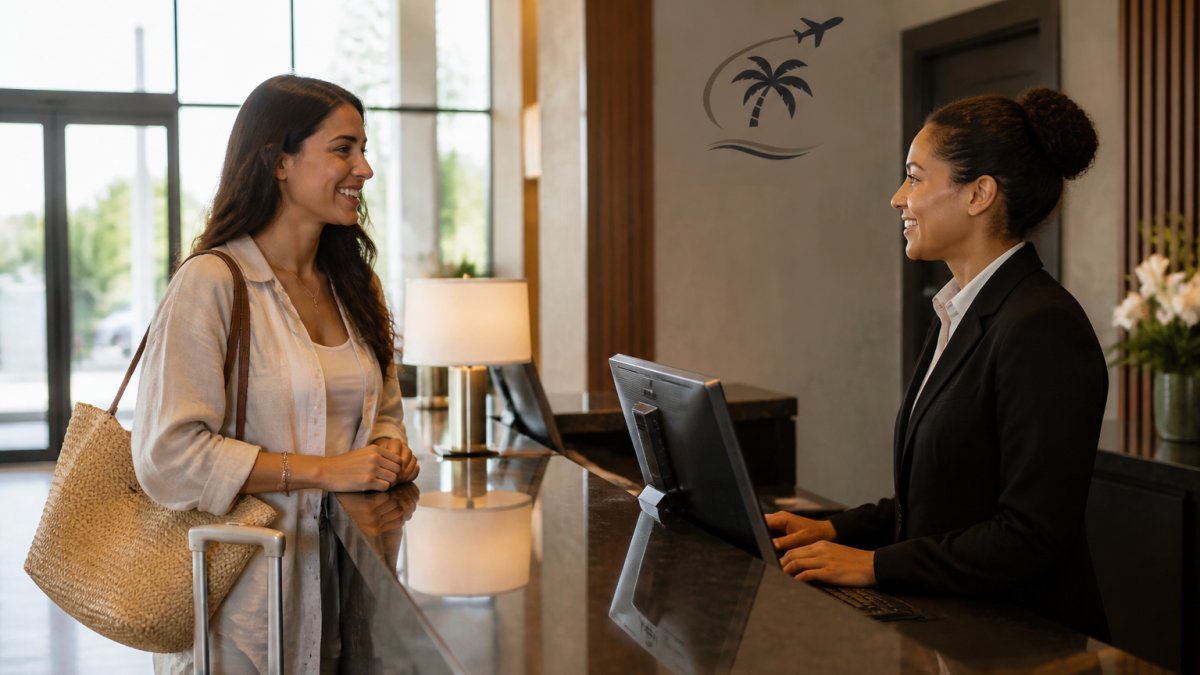
Here is what most guides miss: the front desk agent does not set hotel policy, they work inside it. Your job is to make saying yes easy for them.
A room upgrade is a move to a higher room category than you booked: a better view, a higher floor, more space, or a suite. It is not the same as a free perk.
Before you ask, know four things:
- Your booking channel and its rules
- Your loyalty status, if any
- How full the hotel looks that night
Get those straight and the conversation takes two minutes.
What Counts as a Room Upgrade and How to Compare Value
Not every upgrade is worth taking. A "higher floor" room with the same layout is a small win. A suite with a separate living area is a real one.
Use this quick value check:
| Upgrade Type | What It Usually Means | Worth Asking For? |
|---|---|---|
| Higher floor | Same room, better elevation | Low value unless view matters |
| Better view | Ocean, city, or garden outlook | Medium, depends on trip |
| Bigger room | More square footage | High for families |
| Suite | Separate living space | High for longer stays |
| Club or lounge access | Breakfast, snacks, workspace | High if you will use it |
Ask the front desk agent one direct question: "What does this upgrade include that my current room does not?" Their answer tells you if it is real value or just a label.
The Hotel Room Upgrade Request Script That Works
A hotel room upgrade request script keeps you calm, clear, and easy to help. Keep it short. Smile. Use the agent's name if you can see it.
Here is a script you can use word for word:
"Hi, I'm checking in under [last name]. I know it's a busy day. If there's any room upgrade available tonight, I'd love to be considered. I'm flexible on room type, and I'm happy to hear what options exist, including paid ones."
Opening Lines and Follow-Up Responses
Pick the opening that fits your situation:
- Loyalty angle: "I'm a repeat guest here. Is there anything available for loyal travelers tonight?"
- Occasion angle: "We're celebrating an anniversary. If an upgrade is possible, it would mean a lot."
- Flexibility angle: "I'm flexible on room type and floor. What's open tonight?"
Then handle the reply:
- "We're fully booked." → "Totally understand. Could you note my request in case something opens up?"
- "We have an upgrade for an extra fee." → "What's the nightly rate difference, and what does it include?"
- "Let me check." → "Thank you, I appreciate you looking."
Best Time to Ask for a Hotel Room Upgrade
The best time to ask for a hotel room upgrade is mid-afternoon, after standard check-in opens, when the front desk can see the night's real room inventory. Ask too early and rooms are not assigned. Ask at peak check-in and the agent has a line behind you.
Reading Occupancy and Arrival Timing
Occupancy decides everything. A full hotel has nothing to give. A soft night has room to move.
Signs of low occupancy:
- The lobby is quiet at check-in
- The agent offers you a choice of rooms unprompted
- Online availability still shows several room types
Signs of high occupancy:
- A long check-in line
- "We're sold out" signs or notices
- Only one room type left online
If the hotel looks full, still ask. Just keep it light and accept a no quickly. Early arrival helps too, because room assignment often happens in the late morning.
Hotel Room Upgrade Cost: What You Might Pay and How to Check
A hotel room upgrade cost varies by property, night, and room category, so no guide can quote a reliable number. What you can control is how you verify the number the front desk gives you before you agree.
Upgrade pricing usually falls into one of four buckets:
- Complimentary: No charge, typically tied to loyalty status, a soft occupancy night, or a direct-booking relationship.
- Flat fee per night: A set dollar amount, often quoted as "$30 a night" or "$50 a night" rather than a percentage.
- Rate difference: You pay the published difference between your booked rate and the higher category's rate for that night.
Ask these questions before you agree, and write the answers down:
- What is the total nightly cost of the upgrade, including all taxes and fees?
- Is the upgrade for the whole stay or just one night?
- Does the upgrade trigger a resort fee or destination fee that was not on my original booking?
Fees, Taxes, and Terms to Confirm Before You Agree
The nightly difference is rarely the real number. In many markets, room tax and a resort or destination fee apply to the higher rate, so a $40 upgrade can land closer to $55 or $60 once the folio is finalized. Ask for the all-in nightly difference, not the room rate difference.
Three terms deserve a direct question:
- Stay length. Confirm whether the upgrade price applies to every night of the reservation or only the first. A one-night upgrade on a four-night stay is a different value calculation.
- Fee stacking. Ask whether the upgrade adds a resort fee, parking tier, or club-access charge that was not in your original rate.
- Reversal. Ask what happens if you want to return to your original category. Some properties allow it; others treat the upgrade as a rate change and will not reverse it without a new reservation.
Booking-Channel Limitations That Decide Who Can Say Yes
The front desk agent can only authorize what the reservation allows. Your booking channel often determines whether an upgrade is even possible at check-in.
- Direct bookings: The hotel controls the reservation, so the front desk can usually reprice, move, or upgrade you on the spot.
- Prepaid and nonrefundable rates: These are frequently locked to the room category you bought. The agent may be able to move you physically but cannot always change the rate or folio.
- Third-party and online travel agency bookings: The hotel often cannot modify the room type or rate because the reservation is owned by the channel. Many front desks will direct you back to the channel that made the booking.
Guests who booked direct with even basic loyalty status get the fastest yes, while guests on prepaid third-party rates get a polite no regardless of how they ask.
That is where a travel advisor earns their keep.
How to Get a Free Hotel Room Upgrade
Free upgrades go to guests who are easy to say yes to. There is no secret code, but there is a pattern: removing friction for the agent.
How to get a free hotel room upgrade:
- Join the loyalty program before you check in, even at the basic tier. A member number on the reservation gives the agent a system prompt to check upgrade eligibility.
- Book direct when you can. Many hotels prioritize direct guests for complimentary moves because the property owns the reservation and the rate code.
- Ask once, politely, and name your flexibility. "Any room type works" is a stronger signal than "I want the suite."
- Travel on soft nights, like Sunday or midweek, when the hotel has unsold inventory it would rather fill than leave empty.
- Mention a real occasion only if it is true. Agents hear invented anniversaries constantly and discount them.
- Be kind to the agent, because goodwill is real currency at a front desk and costs you nothing.
Skip the tips about slipping cash before you ask. It reads as pressure, and many agents will refuse it or route it to a manager.
What a Free Upgrade Actually Trades On
A complimentary upgrade is not charity. It is the hotel moving unsold inventory to a guest likely to spend more, return, or leave a strong review. Understanding that trade helps you ask in the right terms.
- Unsold inventory: If a higher category is empty at 4 p.m., the hotel gains nothing by holding it. Your ask gives the agent a reason to use it.
- Length of stay: A one-night guest is an easier upgrade than a five-night guest, because the hotel risks less inventory.
- Repeat behavior: A guest who mentions a past stay, even a single one, signals future revenue.
Follow-Up Wording When the First Ask Gets a Maybe
Most free upgrades are won on the second sentence, not the first. If the agent hesitates, keep it low-pressure and give them an easy path to yes later.
- If they say "let me check": "Thank you, I appreciate you looking. If nothing is open now, I'm happy to be on a list for later tonight."
- If they say "we're fully booked": "Totally understand. Could you note my request in case something opens up? I'll check back after dinner."
- If they offer a paid upgrade instead: "Thanks for checking. What's the all-in nightly difference? I may take it if the value is there."
Step-by-Step Check-In Decision Tree: From Ask to Acceptance or Refusal
Use this decision tree at the desk to keep moving and avoid over-asking.
- Check in normally. Hand over your ID and card. Be warm.
- Ask the open question. "Is there any upgrade available tonight?"
- If yes, free: Confirm what changes. Ask about view, floor, and size. Accept if it fits your needs.
- If yes, paid: Ask for the nightly difference with taxes. Compare it to the value table above. Accept or decline.
- If no: Ask them to note your request. Then ask one follow-up: "If something opens later, can you call my room?"
- If your assigned room has a problem: Report it right away, before you unpack. A broken AC or a noisy location is a fair reason to ask for a move.
If the answer is no, take it well.
For travelers who want the upgrade handled before arrival, this is exactly the kind of detail our team at Sand and Sun Travels manages for honeymoons and family trips. You can request a quote.
The front desk is not a negotiation table. It is a conversation with a person who wants your stay to go well.
If you would rather not leave it to chance, Sand and Sun Travels can build the ask into your booking.
Frequently Asked Questions
How much should you tip the front desk for a room upgrade?
Tipping is not required to ask for an upgrade, but a $10 to $20 tip handed discreetly after a successful upgrade is a common gesture of appreciation. Never offer cash before the request, as it can be perceived as a bribe and may violate hotel policy. If the front desk agent goes out of their way to find you a better room, a tip is a nice way to say thanks. Some hotels prohibit staff from accepting cash, so a sincere thank-you and a positive review are always appropriate.
When is the best time to ask for a hotel room upgrade?
The best time to ask for a hotel room upgrade is during check-in, ideally after 3 p.m. when the hotel knows which rooms are available. Avoid peak check-in hours (4-6 p.m.) when front desk agents are busiest. If you arrive early, ask if an upgrade might be possible later and offer to return. Midweek stays and off-peak seasons generally have more room inventory, increasing your chances. Always check availability before making the request.
What should you do if the hotel says no to an upgrade?
If the hotel says no, remain polite and ask if a paid upgrade might be available at a reduced rate. Sometimes a small additional cost can secure a better room. You can also ask to be placed on a waitlist for cancellations or request a different room type with a better view or higher floor. If the assigned room has a problem, such as noise or a maintenance issue, report it immediately to the front desk manager. A gracious attitude often leads to future upgrades on repeat stays.
Can you ask hotels for free room upgrades?
Yes, you can ask hotels for free room upgrades, but there is no guarantee. Hotels often upgrade guests based on loyalty status, special occasions, or available inventory. To increase your chances, be friendly, flexible about room type, and mention any special occasion. Avoid demanding a free upgrade; instead, frame it as a request. Many hotels will offer a complimentary upgrade if they have unsold premium rooms, especially during slower periods. Always confirm any additional fees or taxes before accepting.