 how-to
How to Pack for a Two Week Adventure Trip With Carry On
Table of Contents
- Start With the Right Carry-On Bag for Adventure Travel
- Know Your Carry-On Size and Weight Limits Before You Pack
- Build a Two-Week Carry-On Packing List Around Your Activities
- How Many Clothes to Pack for Two Weeks (Without Overpacking)
- Use the 5-4-3-2-1 Packing Rule as Your Framework
- Folding, Rolling, and Packing Cubes That Save Real Space
- Plan for Laundry, Weather, and Safety on a Two-Week Trip
- Frequently Asked Questions
Last Updated: October 15, 2026
Start With the Right Carry-On Bag for Adventure Travel
For a two-week adventure trip, a 40-liter carry-on backpack with a clamshell opening beats a hard-shell suitcase: it lets you carry on packing bulky gear, rides on your back over rough ground, and fits most overhead bins.
The travelers who pack lightest start with the bag, not the clothes.
Here is how to choose:
- Backpack: Best for hiking, hostels, and multi-stop trips
- Soft-sided suitcase: Best for resort stays with one adventure day
- Hard-shell: Best for flights only, worst for uneven ground
Whichever you pick, check the empty weight first, every pound the bag costs is a pound of clothing you cannot bring.
Carry-On vs. Personal Item: What Goes Where
Your personal item is your survival kit; your carry-on is your wardrobe. Pack medications, documents, one outfit, and chargers in the personal item. If your carry-on gets gate-checked, you still have what matters.
Know Your Carry-On Size and Weight Limits Before You Pack
Carry-on size and weight limits vary by airline and change often. The standard domestic carry-on is 22 x 14 x 9 inches, but budget carriers often shrink that, so check your airline's page before you buy a bag.
For the current rules, see the TSA carry-on guidance and your airline's own baggage page.
Weigh your packed bag at home on a luggage scale. A bag that fits but weighs too much gets checked at the gate.
Domestic vs. International Airline Rules
Domestic flights usually allow a 22 x 14 x 9 inch carry-on plus a personal item. International carriers often cap weight instead, sometimes at 7 kilograms (roughly 15 pounds), so weigh your bag before every international leg.
| Rule Type | Typical Domestic | Typical International |
|---|---|---|
| Size limit | 22 x 14 x 9 in | 21 x 14 x 8 in |
| Weight limit | Rarely enforced | Often 7 kg (15 lb) |
| Personal item | Usually included | Sometimes not |
| Gate-check fee | Common on full flights | Common on small aircraft |
Rules shift, so confirm yours in writing before departure.
Build a Two-Week Carry-On Packing List Around Your Activities
Your two-week carry-on packing list starts with your activities, not your closet. Write down what you will actually do each day, then pack only for those days. A mixed trip needs a modular system rather than a compromise loadout.
Start with this base layer of clothing, then add activity gear on top:
- 5 tops, 3 bottoms, 2 dresses or button-downs
- 1 light jacket, 1 rain shell
- 7 pairs of underwear and socks
That base covers most trips. Adventure gear gets added on top, and the key word is modular. Pack gear that serves more than one activity, and rent anything single-use.
Adventure Gear by Activity Type
Match gear to the activity, and nothing else. Add only the rows below that match your itinerary.
Hiking and trekking
- Broken-in trail shoes or boots (wear them on the plane)
- A 15-20 liter packable daypack that stuffs into your main bag
- Blister care: leukotape or moleskin, plus a small foot balm
Water activities (snorkeling, kayaking, paddleboarding)
- Quick-drying swimsuit and a rash guard for sun and chafe protection
- A 10-20 liter dry bag for phone, wallet, and a dry layer
- Water shoes or strappy sandals that stay on in surf
Cold-weather and alpine
- Base layer: merino or synthetic, one set
- Mid layer: fleece or light puffy that compresses to the size of a grapefruit
- Shell: packable rain jacket with taped seams and a hood
Camping and multi-day backcountry
- A shelter you will actually carry, a tarp or one-person tent, not a four-person dome
- A 20°F-rated sleeping bag only if nights demand it; otherwise a liner plus a rented bag
- A headlamp with spare batteries
Desert and hot-climate
- Loose, light-colored long sleeves for sun protection
- A wide-brim hat with a chin strap
- Electrolyte tablets, they weigh almost nothing and save a bad afternoon
Urban and cultural days between adventures
- One pair of clean, packable shoes or sandals
- One outfit that reads as "nice enough" for a restaurant or temple
- A small crossbody bag that folds flat in your main bag
How to Decide What Earns a Spot
Run every piece of gear through three questions before it goes in the bag:
- Is it on the itinerary? If you have not booked the activity, leave the gear home.
- Can I rent it? Trekking poles, snorkel gear, helmets, and heavy boots are cheap to rent and miserable to carry.
- Does it do two jobs? A buff works as a neck gaiter, sleep mask, and pot holder. A dry bag works as a stuff sack, laundry bag, and pillow.
A Worked Example: Seven-Day Trek Plus Five Beach Days
Here is how the modular system plays out on a real mixed itinerary:
- Clothing base: 5 tops, 3 bottoms, 7 underwear and socks, 1 swimsuit, 1 hat
- Hiking add: trail shoes (worn), daypack, blister kit, 1 trekking pole
- Beach add: rash guard, dry bag, water shoes, microfiber towel
That loadout fits a 40-liter carry-on with room to spare because the two activity kits share layers.
How Many Clothes to Pack for Two Weeks (Without Overpacking)
The honest answer to how many clothes to pack for two weeks is fewer than you think.
The math works because laundry resets the count. If you can wash on day seven, you only need to pack for seven days.
Here is the math that works for a two-week trip with one mid-trip wash:
- Tops: 5 (one worn on the plane)
- Bottoms: 3 (one worn on the plane)
- Underwear and socks: 7 pairs
That is roughly 20 items, and it fits a 40-liter bag with room for gear. Laundry once mid-trip resets the whole count.
Why the Numbers Are What They Are
Each count comes from a trade-off, not a rule:
- 5 tops covers a week if you rewear each top twice between washes. Fewer means sink laundry every other night; more means carrying weight you will not use.
- 3 bottoms works because bottoms do not touch your skin the way tops do. Two pairs of pants or shorts plus one skirt or dress covers every combination.
- 7 underwear and socks is the one category where you should not cut corners, they are small, light, and the first thing to feel dirty.
How Fabric Choice Changes the Count
Quick-drying, odor-resistant fabrics let you rewear clothing between washes, cutting your clothing count without cutting comfort.
- Merino wool resists odor for several wears and regulates temperature. It costs more but replaces two or three cotton items.
- Synthetic blends dry in hours and pack small, the workhorse for adventure travel.
- Cotton holds odor and water. Leave it home on a two-week trip.
If your whole wardrobe is merino and synthetic, you can drop to 4 tops and 2 bottoms. If you are packing cotton, add a top and a bottom to compensate.
Laundry Cadence: The Real Variable
Plan laundry for day seven. A sink wash works for small items; a laundromat handles the rest.
- Sink wash (every 2-3 days): underwear, socks, and one top. Takes 10 minutes and dries overnight in a towel roll.
- Laundromat (once per week): everything. Costs a few dollars in quarters and takes about an hour.
- Hotel laundry service: convenient but expensive. Use it only for emergencies.
If you can wash every three days, you can pack for four days instead of seven, a 40% reduction in clothing weight.
A Reproducible Loadout
Here is the full list, with quantities:
| Category | Quantity | Notes |
|---|---|---|
| Tops | 5 | 1 worn on plane, 4 packed |
| Bottoms | 3 | 1 worn on plane, 2 packed |
| Underwear | 7 | One per day between washes |
| Socks | 7 | One per day between washes |
| Shoes | 2 | 1 worn, 1 packed |
| Swimwear | 1-2 | Doubles as base layer |
| Base layer | 1 | Merino or synthetic |
| Mid layer | 1 | Fleece or light puffy |
| Shell | 1 | Packable rain jacket |
| Hat | 1 | Sun or warmth, depending on climate |
| Toiletries | 1 kit | Travel-size, clear bag |
| Chargers and adapter | 1 set | Personal item |
| Documents | 1 set | Paper plus digital copies |
That is the whole wardrobe. Everything else in the bag is activity gear, which follows the modular rules above.
Common Miscounts to Avoid
- Packing for the trip length instead of the wash interval. A 14-day trip with one wash is a 7-day pack.
- Adding "one nice outfit" for every possible occasion. One outfit covers every nice occasion.
- Counting the worn clothes as extra. The clothes on your body are part of the count.
Use the 5-4-3-2-1 Packing Rule as Your Framework
The 5-4-3-2-1 packing rule keeps a carry-on from overflowing: 5 tops, 4 bottoms, 3 pairs of shoes, 2 jackets, and 1 hat. It forces a decision before you pack, not at the airport.
Adjust it for your trip:
- Cold trip: 5 tops, 4 bottoms, 2 shoes, 3 layers, 1 hat
- Beach trip: 5 tops, 4 bottoms, 2 shoes, 1 cover-up, 1 hat
- Mixed trip: 5 tops, 4 bottoms, 3 shoes, 2 jackets, 1 hat
The rule is a starting point, not a law. Use it to stop the "one more shirt" spiral.
Folding, Rolling, and Packing Cubes That Save Real Space
Compression packing cubes and rolling clothes save the most space. Roll soft items like shirts and leggings, fold structured items like jackets, and compress everything into cubes, carry on packing this way and a 40-liter bag can hold a full two-week wardrobe.
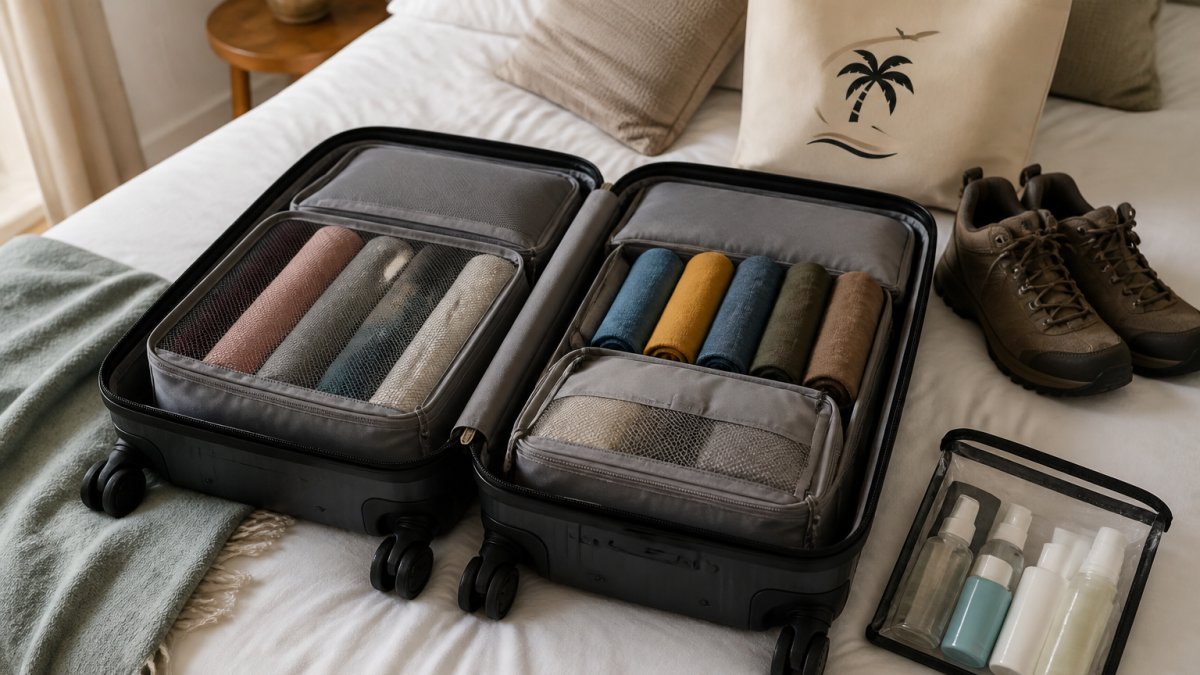
The method matters less than the system:
- One cube for tops, one for bottoms, one for small items
- Roll knits and cotton, fold collars and structured pieces
- Stuff socks and underwear into shoes
A common mistake is packing cubes too full. Overstuffed cubes do not compress, and they turn your bag into a brick.
Plan for Laundry, Weather, and Safety on a Two-Week Trip
Laundry, weather, and documents are the three things that break a two-week carry-on plan. Book accommodation with laundry access at least once, pack for layering, and carry copies of your passport and insurance.
Plan laundry for day seven. Weather changes fast on adventure trips, so pack a base layer, a mid layer, and a rain shell instead of one heavy coat, layering handles cold mornings and warm afternoons.
For safety and documents:
- Carry digital and paper copies of your passport
- Pack medications in original containers in your personal item
- Keep emergency contacts and insurance details offline
Frequently Asked Questions
How do you travel for two weeks with just a carry-on?
Start with a carry-on packing strategy built around a capsule wardrobe: 8-10 tops, 3-4 bottoms, and 2-3 pairs of shoes that all mix and match. Use the 5-4-3-2-1 rule as a quick framework (5 tops, 4 bottoms, 3 accessories, 2 pairs of shoes, 1 hat or jacket). Pack quick-drying, odor-resistant fabrics so you can rewear items and hand-wash along the way. Choose a bag that meets your airline's carry-on size and weight limits, and wear your bulkiest items on travel days.
What is the 5-4-3-2-1 rule for packing?
The 5-4-3-2-1 packing rule is a simple framework: 5 tops, 4 bottoms, 3 accessories (like a scarf, belt, or jewelry), 2 pairs of shoes, and 1 hat or jacket. It works because each piece should mix and match with the others, giving you more outfit combinations from fewer items. For a two-week adventure trip, adapt it with activity-specific gear: swap one pair of shoes for hiking boots, and choose quick-drying fabrics that handle sweat and rain. The rule keeps your carry-on light while covering every day of your trip.
How big of a carry-on do you need for a two-week trip?
Most domestic airlines allow a carry-on up to 22 x 14 x 9 inches, while international carriers often cap it at 21 x 14 x 9 inches or measure by linear dimensions (usually 45 inches total). For a two-week trip, a 40-45 liter capacity works well if you pack a capsule wardrobe and use compression packing cubes. Always check your specific airline's carry-on size and weight limits before buying a bag, since weight caps can range from 15 to 50 pounds depending on the carrier and fare class.
What is the most forgotten item when packing for a vacation?
Travelers most often forget chargers and power adapters, followed by medications and prescription refills. For a two-week adventure trip, also pack a small first-aid kit, blister treatment for hiking days, and copies of essential documents (passport, insurance, reservations) stored separately from the originals. A travel-size toiletry bag with refillable bottles prevents last-minute purchases. Create a checklist on your phone and review it against your two-week carry-on packing list the night before departure to catch anything you missed.
A two-week adventure on carry-on luggage only comes down to planning: the right bag, a realistic clothing count, and a laundry day on the calendar. That is exactly the kind of trip we build at Sand and Sun Travels. Our Fora-certified advisors create fully customized itineraries, secure VIP upgrades and resort credits through our industry partnerships, and stay reachable before, during, and after your trip. Get started with Sand and Sun Travels and pack once, adventure more.