 listicle
The Packing List for Language Learning Family Trips
Last Updated: November 9, 2026
Quick Summary
A packing list for language learning family trips combines standard family travel gear with study tools, translation devices, and cultural items for practicing a new language on the road. Pack study materials in compression packing cubes in the cabin bag so workbooks, journals, and chargers never get buried under the swimsuits.
- Build the study kit in three layers: paper references, writing tools, and offline digital backups.
- Download offline language packs at home on reliable Wi-Fi and test camera translation before departure.
- Pack a portable charger for each adult, a universal power adapter, and one multi-port charging hub.
- Keep every power bank in carry-on luggage, since spare batteries cannot go in checked bags.
- Pack a light scarf per person, since many religious sites require modest dress.
Table of Contents
- Start With a Language Learning Packing List That Works
- 1. Carry-On Luggage and Packing Cubes That Keep Study Gear Separate
- 2. Language Learning Gear: Phrasebooks, Journals, and Offline Apps
- 3. Electronics and Charging Gear for Translation and Remote Schooling
- 4. Clothing, Toiletries, and First Aid for Every Climate
- 5. What to Pack for a School Trip and Cultural Etiquette Items
- 6. Your Printable Packing List for Language Learning Family Trips
- 7. Packing List for School Trip and Family Vacation Packing List PDF Options
- Frequently Asked Questions
Start With a Language Learning Packing List That Works
A packing list for language learning family trips is a pre-departure checklist that covers standard family travel gear plus the study tools, translation devices, and cultural items a family needs to practice a new language on the road. At Sand and Sun Travels, we build these lists around one idea: the study gear should never get buried under the swimsuits.
Most family packing guides ignore the language side of the trip entirely. That is a mistake. When the phrasebook is in the checked bag and the charger is dead, the learning stops.
Below, we break down exactly what to pack, section by section, so every family member arrives ready to talk.
1. Carry-On Luggage and Packing Cubes That Keep Study Gear Separate
The biggest packing mistake we see is mixing study materials into the general luggage pile. Keep them in the cabin bag instead.
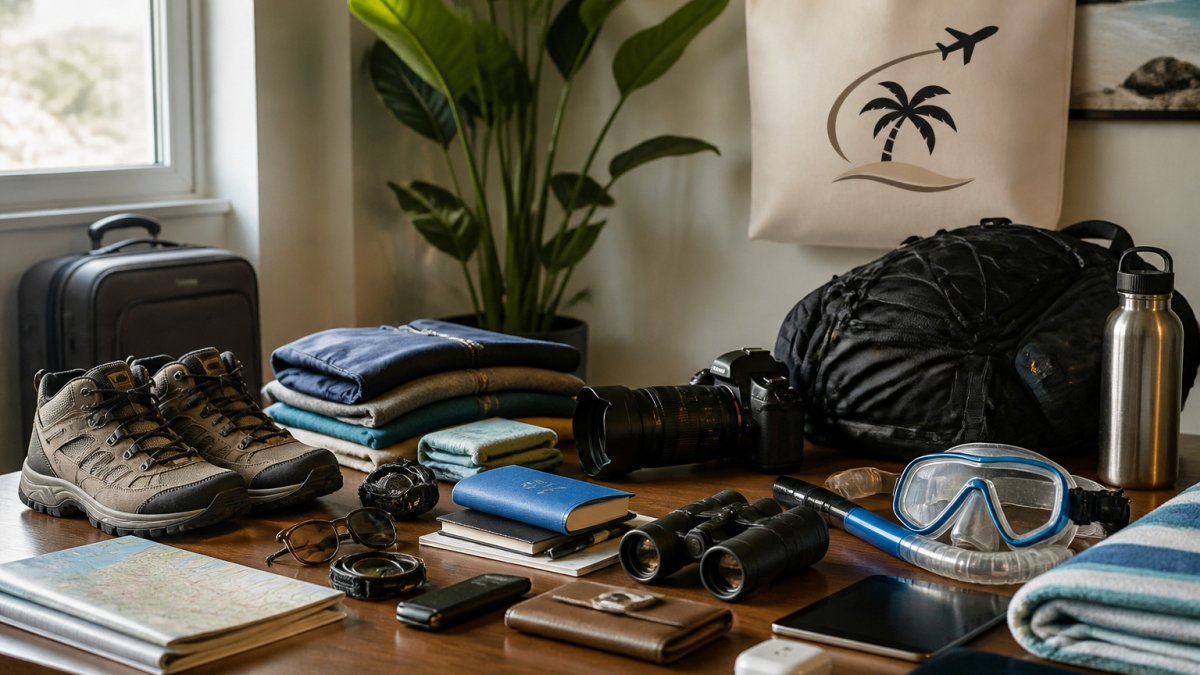
Pack study materials in compression packing cubes so workbooks, journals, and chargers stay in one cube, clothes in another. If you want a carry-on-only method to copy, our guide on how to pack for a two week adventure trip with carry on walks through it step by step.
Watch out: cube sets sold separately tempt you to overpack. One cube per person is plenty for a study trip.
2. Language Learning Gear: Phrasebooks, Journals, and Offline Apps
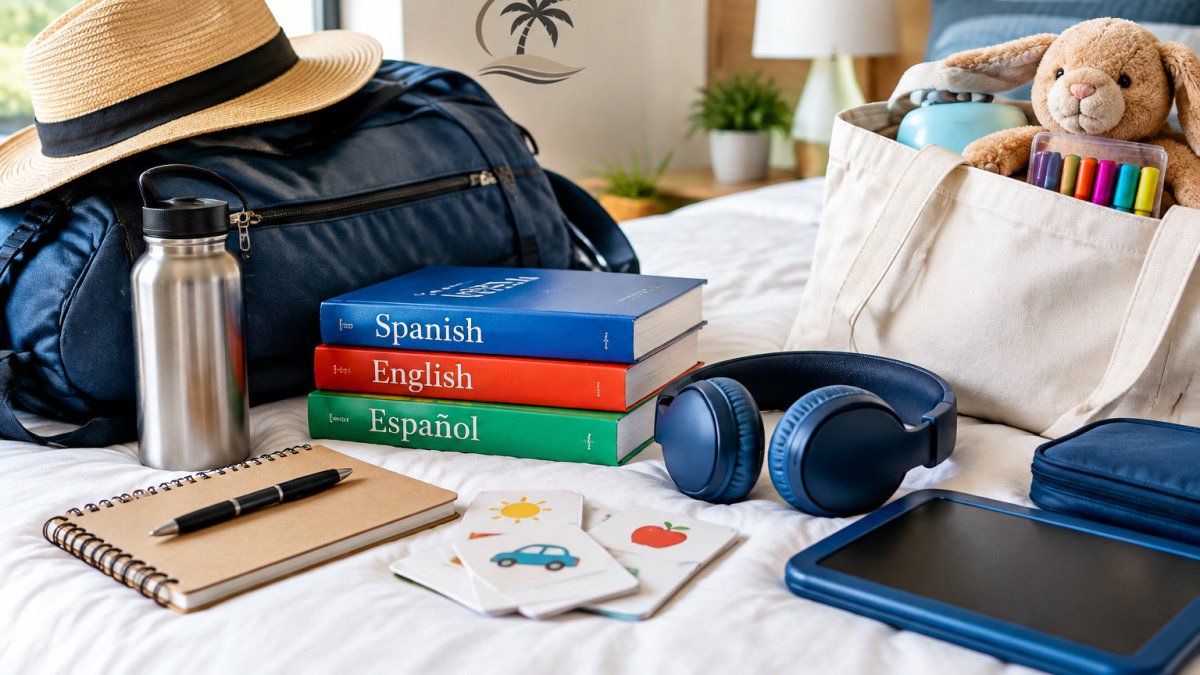
This is the section most family packing guides skip entirely, and it is the one that decides whether the trip actually produces language practice. Build the study kit in three layers, paper, writing tools, and offline digital backups, because Wi-Fi fails at the worst moments and a dead app mid-conversation teaches kids that the gear is unreliable.
Paper references that need no battery. A pocket bilingual dictionary or phrasebook still earns its slot: it works in a subway tunnel, on a plane, and at a market stall where you do not want to hand a stranger your phone. For younger children, a picture dictionary with labeled scenes lets a five-year-old point and name without reading fluency.
Writing tools that create practice. A travel journal is a practical choice, but the mechanism matters more than the brand: each child needs a place to log new words, sketch a menu, and paste ticket stubs, because writing a word by hand is what moves it from recognition to recall. Add a small pack of index cards and a binder ring for physical flashcards, ten cards a day, reviewed at breakfast, beats an hour of passive app scrolling.
Offline digital backups. Before you fly, download the offline language packs in your translation app of choice, save offline maps for every city on the itinerary, and cache any audio lessons your kids use at home. A translation app with a camera mode is genuinely useful for menus and signs, but it is a backup, not the plan, the goal of the trip is conversation, and a phone held between two people is a barrier, not a bridge.
Age-tier the kit. Preschoolers: picture dictionary, crayons, a sticker book with target-language labels. Elementary: flashcards, a simple journal, a phrasebook with pronunciation guides. Tweens and teens: their own translation app logins, a vocabulary journal, and a small notebook for writing short daily entries in the target language. Adults carry the shared phrasebook, the backup charger, and the list of phrases the whole family is practicing that week.
Watch out: downloading offline packs the night before departure is the single most common failure, do it at home on reliable Wi-Fi, open each pack once to confirm it loaded, and test the camera translation on a cereal box before you trust it abroad.
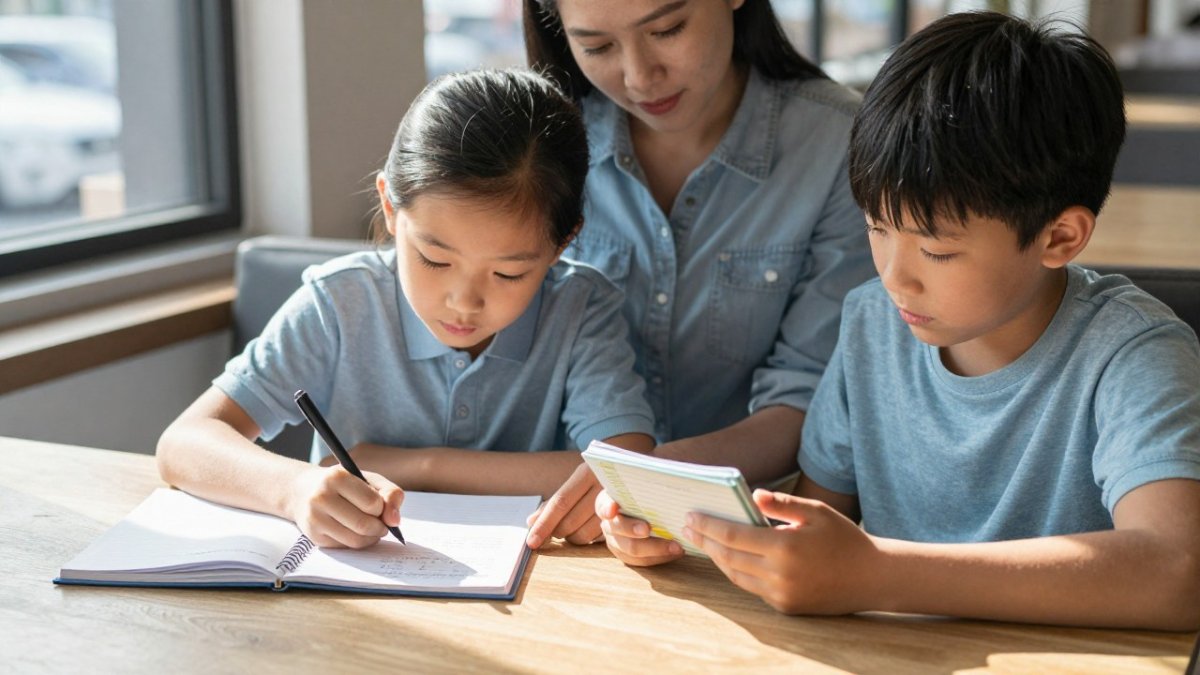
Spanish-speaking families planning a language-focused trip can go deeper with our bilingual travel planning for Spanish speakers resources.
3. Electronics and Charging Gear for Translation and Remote Schooling
Electronics are the backbone of a modern language trip. One dead phone can strand a family without translation, maps, or schoolwork.
Pack a portable charger for each adult, a universal power adapter, and a single multi-port charging hub instead of four separate bricks. Families doing remote schooling should add a lightweight tablet, headphones for each child, and a small stand.
Keep every power bank in carry-on luggage, per TSA rules. A TSA guide to lithium batteries confirms spare batteries cannot go in checked bags.
4. Clothing, Toiletries, and First Aid for Every Climate
Clothing, toiletries, and health supplies should follow a layering system, not a guessing game. Build a capsule wardrobe where every top matches every bottom.
- Layering clothes: three tops, two bottoms, one warm mid-layer, one rain shell per person
- Weather-appropriate footwear: one broken-in walking shoe, one sandal
- Toiletry kit: travel-sized everything, in a clear TSA-compliant bag
- First aid kit: bandages, motion sickness tablets, children's fever reducer, prescriptions in original packaging
Check the CDC travel health guidance for destination-specific vaccinations before you pack the kit.
5. What to Pack for a School Trip and Cultural Etiquette Items
What to pack for a school trip goes beyond clothes: it includes the small items that show respect for the host culture and, just as important, open the door to conversation. Etiquette gear is language gear, the family that arrives prepared to dress and behave appropriately gets invited into more conversations than the family that does not.
Research the dress code before you pack, not after. Religious sites are the most common friction point. Many religious sites require modest dress, so check each site's rules before you pack. A light scarf per person (large enough to wrap as a shoulder cover or head covering) solves most of this in one item.
Footwear is etiquette. Shoes come off at the door in homes, temples, and many restaurants across Asia and the Middle East. Slip-on shoes for every family member make those transitions fast and graceful, and a pair of socks in the bag means nobody is barefoot on a cold stone floor.
Small gifts for hosts and homestays. If your family is staying with a host family or doing a language homestay, a small gift from home is customary in most cultures. Useful, lightweight choices: a photo book of your city, a locally made snack that travels well, a children's book in English with pictures (which doubles as a language exchange, the host child reads it to yours).
Table and greeting basics to pack in your head. The items are small, but the preparation is the point: learn whether the culture shakes hands, bows, or kisses cheeks; whether you eat with the right hand; whether tipping is expected. Write the three or four rules your family will actually follow on an index card and keep it in the phrasebook. Children follow what parents model, so practice the greeting at home before you go.
School-trip specifics. For a formal school trip, the packing list usually comes from the school, follow it exactly, then add the etiquette layer: a nicer outfit for a formal dinner or ceremony, a small daypack for site visits, and a refillable water bottle. Label everything, because group trips lose items at a rate that surprises first-time parents.
Watch out: packing only for the beach and then discovering the itinerary includes a cathedral, a temple, and a home visit is the classic family-trip mistake, read the full itinerary against the dress rules before the suitcase closes.
Families traveling in a group should read our tips on organizing group travel with language barriers before departure. Parents planning a bilingual family trip will also find our bilingual travel planning for families guide useful for splitting language duties between adults.
6. Your Printable Packing List for Language Learning Family Trips
Here is the checklist we hand to families before every departure. Print it, or load it into a shared app.
| Category | Item | Who Carries It |
|---|---|---|
| Documents | Passports, copies, emergency contacts | One adult |
| Study gear | Phrasebook, journal, offline apps | Each child |
| Electronics | Charger, power adapter, power bank | One adult |
| Health | First aid kit, medications | One adult |
| Clothing | Layered capsule wardrobe | Each person |
A shared family organizer app can sync this list across every phone in the family.
7. Packing List for School Trip and Family Vacation Packing List PDF Options
A family vacation packing list PDF works best when it is built once and reused. Start with a master document, then delete what does not apply to each trip.
Building a Family Vacation Packing List PDF
- Open a free template in Google Docs or Canva.
- List categories down the left: documents, study gear, electronics, clothing, health.
- Add a column for each family member.
- Save as PDF and share it in your family group chat.
- Update it after every trip with what you forgot.
For more destination ideas and family travel tips, browse our travel inspiration collection.
Language trips reward preparation more than almost any other kind of travel. The families who arrive with charged devices, packed phrasebooks, and a shared checklist are better placed to spend their energy on conversations. That is exactly the kind of trip we plan at Sand and Sun Travels. Our bilingual advisors build fully customized itineraries and provide support before, during, and after your trip. Get started with Sand and Sun Travels and turn your next family journey into a language adventure your kids will remember.
Frequently Asked Questions
What should a family pack for a language-learning trip?
Beyond standard travel essentials, a language learning packing list should include pocket phrasebooks, a travel journal for new vocabulary, a high-capacity portable charger for translation apps, and offline maps downloaded before departure. Pack study materials in packing cubes so they stay separate from clothing, and keep passports and IDs in an RFID-blocking hip pack. Families with toddlers should add a dedicated gear bag with quick-access compartments for snacks and diapers.
What language-learning supplies are useful to bring on a family trip?
Compact phrasebooks need no battery or internet, which makes them reliable in rural areas. A travel journal gives kids a place to record new words and cultural notes. Pair those with a translation app on a charged phone and a portable charger so devices last through long days of walking tours and classes.
Can you make a printable packing list for a language-learning family trip?
Yes. Start with categories: travel documents, study gear, clothing, toiletries, first aid, and electronics. List each item once, then add a column for who is responsible. Family organizer apps let you build a shared checklist that syncs across phones. Print one copy per family member and have each person check off items as they pack.
What should children pack for a school or language immersion trip?
Children need weather-appropriate layers, a refillable water bottle, a small day bag, and their own study materials. Add a compact first aid kit, travel-sized toiletries in TSA-compliant containers, and a printed card with emergency contacts. If the trip involves remote schooling, include a lightweight laptop or tablet plus a power adapter for the destination. Check airline weight restrictions before packing checked baggage so nothing gets repacked at the counter.
How do you keep kids entertained during a long family trip?
Pack a mix of educational and offline activities: a travel journal, flashcards for the target language, downloaded audio lessons, and a few compact games. A small backpack that fits under most airline seats keeps a child's entertainment within reach. Load offline maps and translation apps before departure, and plan short language games at airports or rest stops so learning becomes part of the journey rather than a screen-time battle.